- Scholarly Source
“The Need to Belong (NTB): Belongingness and Human Performance.” http://myweb.fsu.edu/bhl08/others/C_Belongingness.pdf
This source explains why people feel an innate need to belong.
Humans have an innate need of belonging. This relates to the desire to maintain positive relationships with others. There are a few bases to the need to belong: the sense of identity, security and orderliness. A sense of identity allows someone to distinguish from the rest; it makes us who we are. Belonging to a group gives people a sense of security. This security leads to an increase in a person’s self-esteem and sense of power. Also, belonging to a structured group of like-minded people gives a person a sense of orderliness, which allows the person to live a simpler life. Groups often have certain rituals, and these rituals allow a person to make less decisions in life and decrease the complexity of their worldview. All in all, a sense of belonging to an organization or a group allows a person to live a happier, secure, stable life.
2. Scholarly Source
Neave, Nick and Daryl B. O’Connor. “Testosterone and Male Behaviours.” The Psychologist, 2009, 4, https://www.researchgate.net/publication/258689495_Testosterone_and_male_behaviours
This source explains the effect that testosterone has on mood and aggression.
The effect of testosterone on mood and aggression is a hot topic in the scientific research world. The pre-conceived notion is that higher levels of circulating testosterone in the male body is associated with behaviours such as anger and physical aggression. However, this is based on observation. Recently, researches gave testosterone pills to a group of men; some with a higher dosage and some with a lower dosage. They studied the effects of an increase in testosterone on aggression and anger levels. Those given a higher dosage showed an increase in those male-typical behaviours (aggression and anger), while those given a smaller dosage showed little to no signs of aggression or anger. The results show that only in big doses does testosterone have a noticeable effect on one’s mood.
3. Non-Scholarly Source
This source explains why so many people feel a need to escape their everyday troubles.
Hundreds of millions of people around the world are constantly glued to some type of screen to, as the author puts it, “watch an electronic reproduction of life.” The author goes on to question what everyone’s need to escape from reality tells us about societal structure. There are a ton of people who are unfulfilled with their everyday lives. A means of escape allows us to put aside our problems for just a little longer and, for a moment, forget the pain in our lives. One of the reasons that we feel this pain is that society is set up to make us doubt how we feel. We are constantly bombarded with instructions on how we should feel, making us question how we do feel.
4. Non-Scholarly Source
This source explains why so many people take pride in the city in which they live.
Surveys taken in the UK and the US show that most people take pride in their city, but they can’t explain why. In the UK city of Brighton, 91% of people take pride in their city, but there was no consistent answer as to why. Some said the local culture as a whole, others said the people, the shops, the nightlife and the restaurants. Another survey taken in 13 metropolitan areas in the US found that 74% of people take pride in their city, but again, there was no clear answer why. The author goes on to explain that the root of pride is not tangible. It is rooted in the bonds, the unspoken links and cues which people experience only in their own city. People in the same city have a sense of togetherness, an intangible emotional attachment to one another. Pride in one’s city is not based on the city itself, it’s based on the people within it who have all shared some of the same experiences.
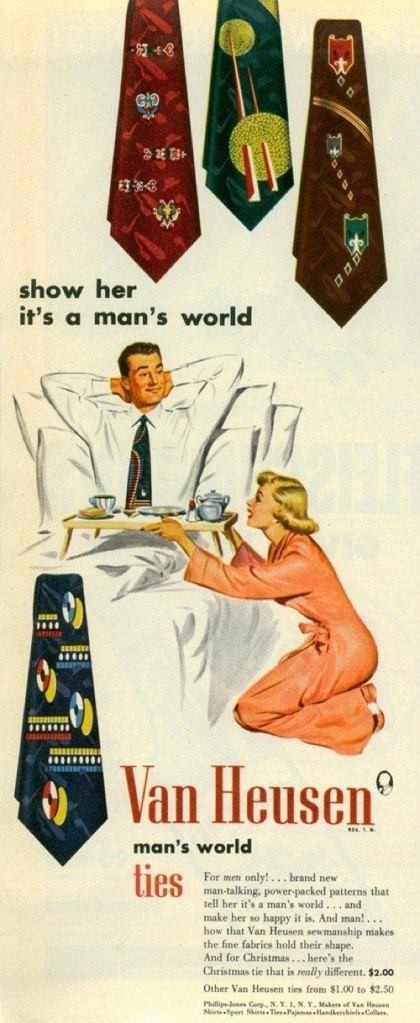
5. Cultural Artifact
It is not hard to find signs of male dominance in society. So many advertisements show men in a dominant position. This 1950s Van Heusen advertisement shows a woman in a submissive position, on her knees, giving food to a man in a dominant position. It is clear that in the past and in the present, men are portrayed as dominant and powerful in society. This can have a negative influence on men as they may see these advertisements and think that they should be dominant in all aspects of life. This leads men into a constant pursuit of power.
6. Experiential Research
Men crave power and dominance. Whether it be controlling a conversation, exerting sexual dominance, or being aggressive, it is clear that in today’s society, men like to be in a dominant position. For the past couple weeks, I have been observing the actions of men around me to see it for myself, and I was surprised by how often you find a man exerting dominance in one way or another. I was watching TV with my brother and my mother last week. I was sitting on one couch, my mom and my brother were sitting on another. I looked over and saw my brother spreading his legs to the point that my mom was crouched up in the corner of the couch. This has become known as “manspreading” and is one way that some men subconsciously exert dominance. Another instance is when I was at the dinner table with my parents and a family friend of ours. I couldn’t help but notice that the man that we were eating dinner with felt the need to interrupt almost every sentence that was said. It was very annoying and it was clear that he needed to have the lead in the conversation. Also, I was at the gym a few days ago and there was a man doing deadlifts. He let out these blaring grunts and slammed the bar on the ground after each set (clearly ignoring the sign that said don’t slam the weights). He obviously wanted everyone in the gym to look at the weight that he was lifting so that he could assert himself as the alpha-male in the room.
 Cameron's Blog