For as long as I can remember, I’ve been a huge football fan. Specifically, the Philadelphia Eagles. After years of mediocrity, the 2017 season was magical for the Eagles. For the first time in franchise history, the Eagles had a shot at hoisting the Lombardi trophy. I put on my midnight green jersey, sat down with my friends, and watched as the Eagles took the field to face the New England Patriots in the Superbowl. The first half of the game was a rollercoaster of emotions. I was jumping on the couch with excitement and then screaming with frustration two plays later. The wild first half came to a close with a perfectly executed trick play to give the Eagles a 22-12 halftime lead. I was glad that halftime came. It gave the players, along with myself, a chance to calm down. The second half came around and right away, the Patriots mounted a comeback. I was absolutely furious. That is, until the Eagles scored to take the lead back. All those feelings went away in the blink of an eye. With the seconds left in the game, the Eagles had an eight point lead. If they could stop Tom Brady and the Patriots one more time, they would become Superbowl champions. My heart was beating through my chest as Brady launched the ball up into the endzone. It seemed like that final play took an hour. The Eagles knocked the ball away and for the first time in franchise history, they had won the Superbowl. The rest was a bit of a blur. I was running around the house screaming with joy. I was on my knees thanking whatever God in heaven made this happen. It was the best feeling in the world. Pure bliss. As my high from the win came down over the next few days, I began to ask myself why I was so damn happy? I mean, in reality, what is my connection to Football and the Eagles? I’ve never even been to Philadelphia! Why do I feel such strong emotions towards this team and this sport?
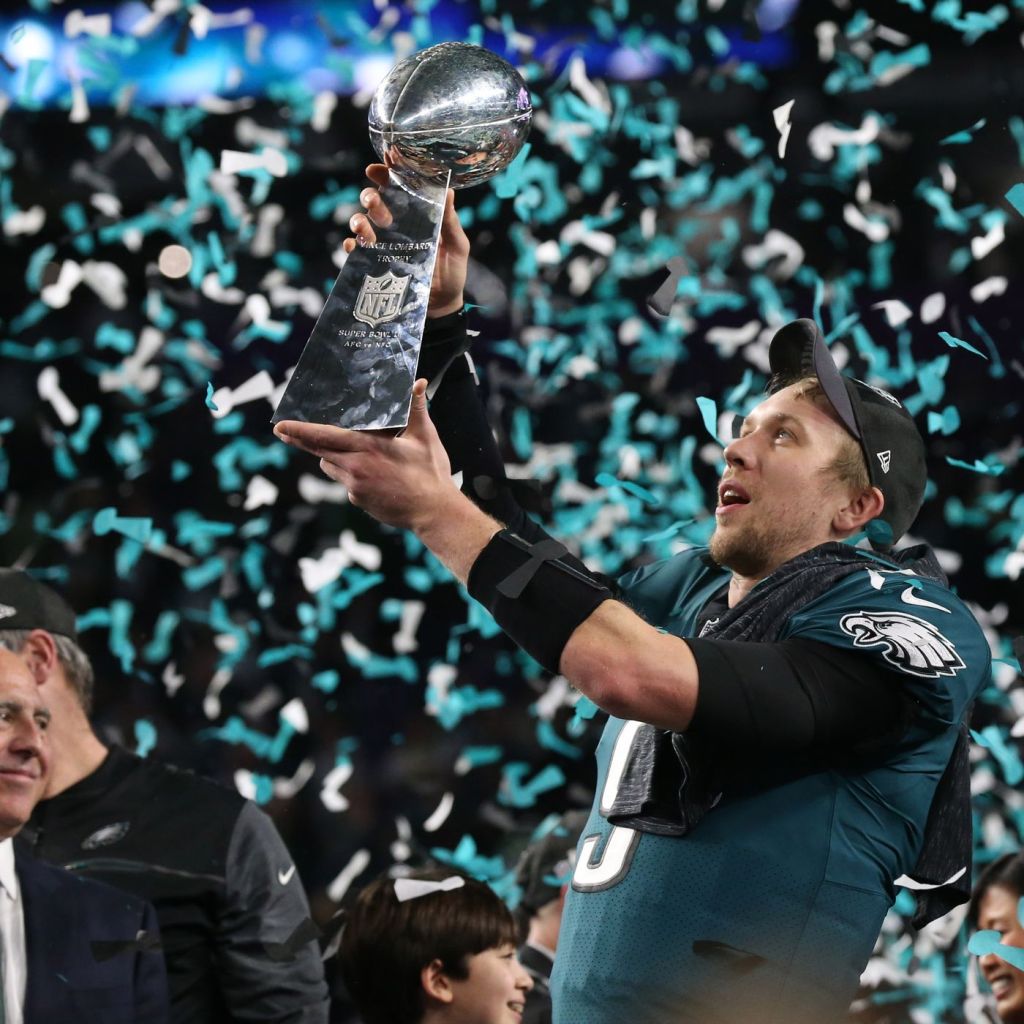
The question “why do I care about sports” is undoubtedly a tough one to answer because it doesn’t lie in the game, it lies in the individual. People like watching sports for a variety of reasons. Many scientists have tried to hone in on what motivates sports fans. Marco Iacoboni, Neuroscientist and professor at UCLA says that mirror neurons play a key role in the brains of sports fans. In a sense, they put the fans’ minds in sync with those of the players. Endocrinologists say that the emotions felt and the hormones released by the fans oftentimes mirror those of the players. The fans see the players as an extension of themselves. This is why fans often refer to their respective teams using “we”. When a football player leaps up into the air to catch a ball, the fan can feel that blood pumping through their veins. When a hockey goalie lets in a goal, the fan can feel that anger and frustration in their gut and the tenseness in their muscles. This internalization and connection is the main reason that fans feel such burning passion for their teams.
Now I want you to picture a sports fan. What do they look like? What do they smell like? How do they act? You’re probably thinking of a sweaty, smelly, overweight man yelling at a TV in an empty bar while slurping down his ninth Budweiser. Well, maybe not exactly, but you are thinking of a man right? That makes sense because most sports fans are male. A study performed by Statista found that 73% of sports fans in the United States are male. Men are drawn to sports by an evolutionary phenomenon known as the spectator lek. According to Robert Deaner, psychologist at Grand Valley State University in Michigan, “the lek is when men display their plumage, overall size or fitness, by engaging in mock- or not-so-mock-combat, while other members of the species observe.” This phenomenon is most commonly found in birds, but is also found in many other species. If we take a look back to the 3rd century BC, we can see humans lekking with gladiator fighting. Fast-forward to now, a time in which fighting to the death in front of a coliseum of people is not as socially acceptable, we take part in the lek by watching sports. It is an evolutionary phenomenon and it’s here to stay. Men enjoy grouping together and watching other men imposing their will on one another. The spectator lek goes a long way in explaining why men have such a burning desire to watch sports.
As I said earlier, the motives behind sports fans lie in the individual. So if you haven’t internalized a team into your identity, and you don’t feel a burning desire to watch men impose their will on one another, then there must be another motive. One of those motives is our innate need for belonging. Since the beginning of humanity, humans have associated with others around them. According to Roy Baumeister and Mark Leary in “The Need to Belong (NTB): Belongingness and Human Performance,” “The need of belonging in human beings is the intrinsic desire to develop and maintain a positive, durable, and noteworthy interpersonal relationship with another human being” (Baumeister and Leary 1). We seek happiness and satisfy that through developing and maintaining positive relationships with others. Sports is one of the ways that we fulfill that need in today’s society. Sports provides a greater identity that people can latch onto. It’s a talking point among strangers, an instant bond between two people wearing the same coloured shirts. For example, when the Philadelphia Eagles score a touchdown, complete strangers at the stadium are wrapping their arms around each other and high-fiving. Two people who would have never otherwise met or interacted now share a bond through “their” team and become friends. Belonging to a group helps to bolster our self-esteem, confidence, pride and ultimately gives us a sense of identity and belonging.

The motives behind members of a sports fan community were studied by researchers at the University of South Alabama in “Conceptualizing Sense of Membership in a Sports Fan Community.” They interviewed the participants to find out what inspired them to seek out a community of like-minded sports fans, and most participants had a similar response. They found comfort in basking in the glory of a win or washing away the sorrows of a loss with others. The main motive behind members of a sports fan community was clear; they all wanted to find others who shared similar emotions. Identifying with a sports team has a significant impact on a fan’s pride. There are highs and there are lows. Sharing these emotions with others provides an important connection and satisfies our need to belong.
One of the greatest examples of a sports fan community is that of Timber Jim and the Portland Timbers. Jim Serrill, known as Timber Jim, was the mascot for Portland’s soccer team, the Timbers. Every time the Timbers scored a goal, Jim would get up in front of the crowd and chainsaw slabs of wood. The fans were crazy for him. In their eyes, he represented the city of Portland as a whole. In 2004, during a match against Minnesota, Jim was told that his 17 year old daughter, Hannah, had died in a car crash. After hearing this tragic news, Jim was devastated. He wanted to give up. He didn’t want to be involved in the Timbers anymore, but the team wouldn’t let him go. The fans and the organization rallied around him and supported him in every way they could. In Jim’s first game back with the team, he was a mess. After the Timbers scored their first goal of the game, Jim did something unprecedented. He went up in front of the fans and started singing his daughter’s favourite song, “You Are My Sunshine” by Johnny Cash. The fans had grown up with Jim, they too were mourning for his late daughter. They all started singing along with him. To this day, in the 80th minute of every Timbers game, you’ll hear the whole crowd singing “You Are My Sunshine.” This is not only a tribute to Jim’s daughter, but an amazing example of the power of a sports fan community.
Like any community, all sports fans are individuals. It is impossible to assign them a collective narrative since all sports fans have their own motives. What drives each person, what inspires each individual to make that attachment differs. Each and every sports fan is driven by their own psychological and physiological sources. Sports serve as a means of uniting people from all walks of life to make something bigger, something meaningful. Some people watch sports because it’s exciting, some people watch sports because they are innately drawn to it, some people watch sports because it’s a topic of conversation, some people watch sports because it provides a sense of belonging. There is no one answer to the question at hand. I said it before and I’ll say it again, not all sports fans are the same. Trying to classify them as one obscures rather than defines the essence of their passion.
 Cameron's Blog